PHP Applications Built for Scale
Dashboards, portals, and internal tools. Modern PHP architecture that survives real production loads.
Legacy PHP Is Costing You More Than You Think
PHP 5.x code written without a framework becomes unmanageable at scale: SQL queries scattered across view files, no separation of concerns, password hashes stored with MD5, and zero test coverage. A typical legacy PHP application takes 3-5x longer to modify than a modern Laravel or Symfony equivalent, and every change risks breaking something unrelated. Aleksandar Rasevic builds applications with PHP 8.2, strict typing, service-oriented architecture, and comprehensive test coverage. Our typical Laravel application bootstraps in under 50ms, handles 2,000+ concurrent requests on a single server with OPcache tuned, and deploys via Docker with zero-downtime blue-green releases.
Sub-50ms Response
OPcache-tuned deployments, query-optimized Eloquent models, and Redis caching for sub-50ms API response times at production load.
Type-Safe Code
PHP 8.2 typed properties, union types, enums, and readonly classes. Caught at compile time, never in production.
Docker Deployments
Containerized with Docker Compose for development and Kubernetes for production. Reproducible builds, zero environment drift.
Applications that handle real load
Custom Dashboards & Reporting
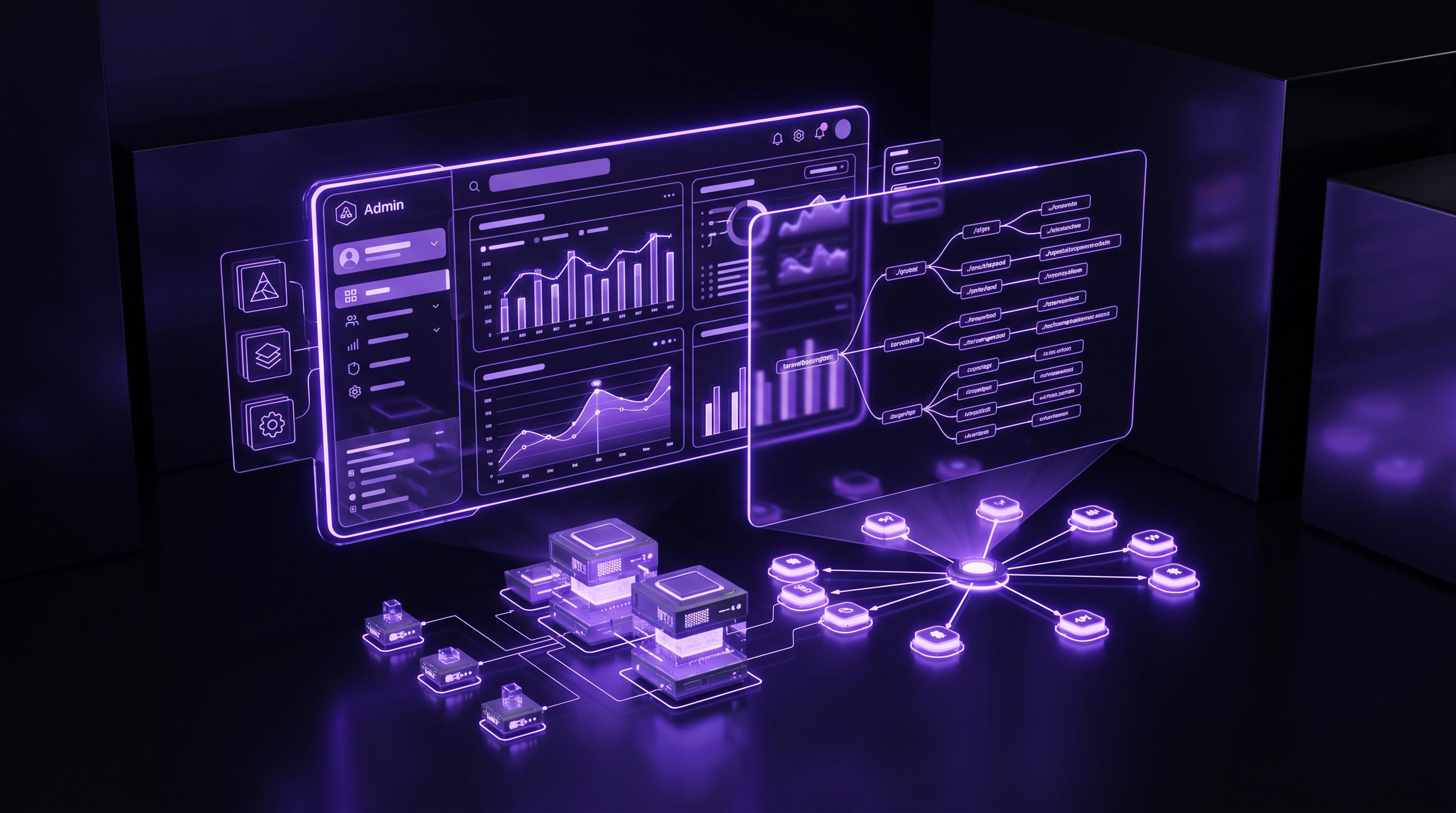
We build analytics dashboards with Laravel as the API backend and Vue.js 3 or React for the frontend. Data aggregation pipelines use Laravel's query builder with optimized selectRaw() and groupBy() for reports spanning millions of rows. We implement materialized views in PostgreSQL for pre-computed metrics, schedule automated report generation via Laravel Scheduler, and export to PDF with DomPDF or to Excel with Maatwebsite/Laravel-Excel. Dashboard widgets are role-based using Laravel's Gate and Policy authorization, with real-time updates delivered through Laravel Echo and Pusher or Soketi.
Client Portals
Secure client portals with multi-tenant architecture using Laravel's Scope for data isolation, role-based access control with Spatie Permission, and document management with Laravel Medialibrary for file uploads, versioning, and secure CDN delivery. Authentication uses Laravel Breeze or Jetstream with two-factor authentication via TOTP, session management with Redis-backed drivers, and brute-force protection through Laravel's ThrottleRequests middleware. Activity logs track every document download, message read, and form submission with IP address and timestamp.
Admin Panel Development
We build internal admin tools with Filament PHP or Laravel Nova for rapid CRUD interface generation, or fully custom React-based admin panels when the interface demands it. Custom admin panels feature drag-and-drop form builders, bulk operation workflows with job queues, advanced filtering with Laravel Scout and Meilisearch, and audit trails with spatie/laravel-activitylog. Every admin action is permission-scoped, searchable, and logged. We implement soft deletes, model versioning, and database transaction rollback for data integrity on complex multi-step operations.
API Development
RESTful APIs built with Laravel's resource controllers, API resource classes for consistent response formatting, and route model binding with implicit scoped bindings. Authentication uses Laravel Sanctum for token-based SPA authentication or Laravel Passport for full OAuth2 server implementations. API versioning is handled through URL prefixes (/api/v1/, /api/v2/) with deprecation headers on sunshined endpoints. We implement rate limiting per user and per IP, request validation with Form Request classes, and comprehensive error responses following RFC 7807 Problem Details. API documentation is auto-generated with Scribe.
Data Visualization
Interactive charts and visualizations using Chart.js, D3.js, or Apache ECharts integrated with Laravel backend data endpoints. We build real-time monitoring dashboards with WebSocket-powered live updates for metrics like active users, transaction volumes, and server health. Geographic visualizations use Leaflet.js with custom tile layers. Export functionality generates static PNG or SVG chart images server-side with Puppeteer for embedding in PDF reports. Data tables use ag-Grid or DataTables with server-side processing for paginating and sorting large datasets without client-side memory issues.
Real-Time Systems
Real-time features powered by Laravel Echo with Soketi or Pusher for WebSocket broadcast, Redis pub/sub for event distribution, and Laravel Queue workers processing background jobs with Horizon monitoring. We build live notification systems, real-time collaborative editing with operational transformation, and live chat systems with conversation persistence in PostgreSQL. Presence channels track which users are online, typing indicators show active participants, and message delivery receipts confirm read status. Event sourcing with spatie/laravel-event-sourcing provides audit trails for every state change.
Integration Hubs
Middleware applications that connect disparate systems: we sync data between your CRM (Salesforce, HubSpot), ERP (SAP, NetSuite), accounting software (QuickBooks, Xero), and internal databases using Laravel's queue system for reliable asynchronous processing. Each integration connector is built as a service class with a consistent interface: authenticate, fetch, transform, validate, and persist. Failed syncs retry with exponential backoff, dead-letter queues capture unprocessable records for manual review, and webhook endpoints receive push notifications from external systems with HMAC signature verification.
Legacy System Modernization
We modernize legacy PHP applications through a phased approach: first, containerize the existing application with Docker for consistent deployment; second, extract business logic into testable service classes with PHPUnit coverage; third, replace raw SQL with Eloquent ORM models and migrations; fourth, introduce a modern frontend with Vue.js or React; fifth, migrate to Laravel or Symfony framework structure. Database migrations are handled with Laravel's schema builder or Doctrine Migrations, and every change is backward-compatible with feature flags enabling gradual rollout. We have modernized applications from PHP 5.2 to PHP 8.2 without a single day of downtime.
How we work
Technical Discovery
We audit your existing infrastructure, codebase, and database schema to understand current bottlenecks and technical debt. We document the entity-relationship model, identify N+1 query problems, analyze slow query logs, and map third-party integrations. For greenfield projects, we define the domain model using event storming workshops and produce a bounded context map. Deliverable: technical specification with architecture decision records (ADRs), database ERD, API contract (OpenAPI), and deployment topology diagram.
Database Design
We design the database schema with proper normalization, indexing strategies, and partitioning for tables expected to exceed 10 million rows. Foreign key constraints ensure referential integrity, and we use PostgreSQL for complex data types (JSONB, arrays, ranges) or MySQL 8 for applications where full-text search and GIS features are critical. Migration files are version-controlled and reversible. We implement database seeders for development environments and write performance benchmarks for critical query paths using Laravel's DB::listen() to catch slow queries during development, not production.
Backend Architecture
We build the backend with Laravel or Symfony following domain-driven design principles: controllers delegate to service classes, repositories abstract data access, and actions encapsulate single business operations. We use Laravel's service container for dependency injection, implement the repository pattern for testability, and write API resources that transform models into consistent JSON structures. Authentication uses Laravel Sanctum or Fortify, authorization is handled through Gates and Policies, and caching strategies are defined per endpoint with Redis as the cache store. Queued jobs process heavy operations asynchronously with Horizon for monitoring.
Frontend Integration
Frontend applications are built as SPAs with Vue.js 3 (Composition API, Pinia state management) or React (hooks, Zustand/Redux). We use Tailwind CSS for utility-first styling and component libraries like Headless UI or PrimeVue for accessible form elements and data tables. API communication uses Axios with automatic token refresh, request deduplication, and global error handling. Build pipelines use Vite for sub-second HMR and optimized production bundles. SSR is implemented with Inertia.js when SEO matters, or as a fully decoupled SPA when the application is behind authentication.
Load Testing
Before launch, we run load tests with k6 and Artillery simulating 2,000+ concurrent users executing realistic workflows: login, data entry, report generation, and file upload. We profile with Laravel Telescope and Blackfire.io to identify memory leaks, N+1 queries, and lock contention. Database query times are analyzed with EXPLAIN ANALYZE, slow queries are optimized with composite indexes, and frequently accessed data is preloaded into Redis. We test failure scenarios: database failover, queue worker crashes, Redis connection loss, and third-party API timeouts to ensure graceful degradation.
Monitoring Setup
Production deployments include comprehensive monitoring: Laravel Telescope for request debugging, Sentry for error tracking with full stack traces and user context, Prometheus and Grafana for server metrics (CPU, memory, disk I/O, queue depth), and Pingdom or UptimeRobot for external uptime checks. Log aggregation uses the ELK stack or Grafana Loki with structured JSON logging from Monolog. Alerting rules notify via Slack or PagerDuty when error rates spike, queue latency exceeds thresholds, or database connection pools near exhaustion. We set up automated database backups with point-in-time recovery and test restore procedures monthly.
Technologies we use
"The logistics dashboard Aleksandar Rasevic built for us reduced our dispatch processing time from 45 minutes to under 8 minutes. That is real ROI on software investment."
Frequently Asked Questions
Do you use a PHP framework or build from raw PHP?
We exclusively use frameworks: Laravel 11 for most new applications and Symfony 7 for enterprise projects with complex domain requirements. We do not build applications in raw PHP. Frameworks provide tested security implementations (CSRF protection, SQL injection prevention, XSS escaping), ORM layers that prevent unsafe queries, queue systems for background processing, and testing infrastructure that would take months to replicate in custom code. Our Laravel applications boot in under 50ms with OPcache enabled, and framework overhead is negligible compared to the development velocity and security benefits gained.
How do you handle database design?
Database design follows a structured process: we model the domain with ERD diagrams using dbdiagram.io or DrawSQL, normalize to third normal form for transactional data, and denormalize selectively for reporting tables. We choose PostgreSQL for applications needing JSONB, full-text search, or GIS features, and MySQL 8 for traditional CRUD applications. Every table gets proper indexing: primary keys, foreign keys with ON DELETE CASCADE where appropriate, and composite indexes for frequently queried column combinations. Migration files are version-controlled and tested in CI. For high-volume tables, we implement partitioning and read replicas.
Can you integrate with our existing systems?
System integration is one of our core strengths. We build REST and SOAP API clients using GuzzleHTTP with automatic retries, circuit breakers for failing endpoints, and request/response logging. For database-to-database sync, we use Laravel's Eloquent models with read-only connections to legacy databases, ETL pipelines for data transformation, and queue workers for reliable batch processing. We have integrated with Salesforce, SAP, NetSuite, QuickBooks, Xero, Stripe, PayPal, Twilio, Slack, Microsoft Graph, and dozens of proprietary internal systems. Every integration includes error handling, retry logic, and a monitoring dashboard showing sync status.
What about real-time features like live notifications?
Real-time features are implemented with Laravel Echo broadcasting events over WebSockets via Soketi (self-hosted) or Pusher (managed). For applications needing live updates, we broadcast model changes through Laravel's BroadcastsEvents trait and listen on the frontend with the Echo JavaScript client. Presence channels track online users, private channels ensure data is only delivered to authorized recipients, and whisper events enable client-side typing indicators. For high-throughput scenarios, we use Redis pub/sub as the broadcast driver with horizontal scaling of Soketi instances behind a load balancer.
How do you ensure application security?
Security is layered at every level of the stack. Application layer: Laravel's built-in CSRF tokens, prepared statements via Eloquent ORM, bcrypt password hashing, and signed URLs for password resets and email verification. Authorization is enforced through Policies and Gates on every controller action. Infrastructure: HTTPS-only with HSTS headers, SQL injection prevention through parameterized queries, XSS protection via automatic escaping in Blade templates, and security headers (CSP, X-Frame-Options, X-Content-Type-Options) configured in Nginx. We run automated security scans with Semgrep and Trivy in CI, dependency audits with composer audit, and penetration testing on production deployments. All secrets are managed through environment variables and Docker secrets, never committed to version control.